 EN
EN



How to Evaluate a Stage Lighting Manufacturer for OEM Projects
Choosing among stage lighting manufacturers for an OEM program is not the same as buying a few fixtures from a catalog. You are evaluating whether a supplier can repeatedly turn your specification, branding, control requirements, and delivery plan into a dependable product program. For distributors, rental companies, and project teams, the strongest starting point is a written evaluation process—not a short list based only on price or a single demo.
This guide helps procurement teams compare stage lighting manufacturers through the questions that reduce uncertainty before a purchase order. It treats technical compatibility, sample approval, quality evidence, communication, and lead-time control as connected decisions. That matters because a good-looking sample does not automatically prove batch consistency.
Start with the OEM brief, not the fixture name
Before comparing stage lighting manufacturers, define the project in a way that both procurement and engineering can use. State the intended venue types, target markets, estimated quantities, launch date, branding requirements, voltage expectations, accessories, packaging, and documentation needs. If the answer is “we need moving heads,” the brief is not yet detailed enough to compare suppliers fairly.
For each fixture category, list the performance points that must be demonstrated and the points that may vary. A 500 W moving-head fixture, for example, may be part of the evaluation, but the supplier should still clarify configuration, control behavior, physical details, labeling, packing, and revision control for the exact version being quoted. Do not infer features from a product name alone.
- Non-negotiables: destination-market requirements, fixture type, control ecosystem, branding, and acceptance criteria.
- Variables to resolve: order quantities, spares, carton artwork, manuals, cable options, and labeling.
- Decision owners: name one contact for technical approvals and one for commercial or schedule changes.
Many buyers start with a price comparison. More accurately, the first comparison should be whether each supplier has understood the same brief. A low quote built on a different configuration creates a false comparison.
Assess product range and control compatibility
OEM projects often need a coherent range rather than one isolated fixture. Ask whether the manufacturer can support the fixture families, accessories, and control discussions your channel needs without promising that every item is available under every condition. Review product documentation against the target project, then request a matrix that shows the model, configuration, software or firmware revision, included accessories, and documentation status.
Control deserves its own checkpoint. DMX512 is widely used as a digital communication protocol for stage lighting and effects, but a compatibility claim should be verified in the intended setup. Ask how the fixture is addressed, how its channel modes are documented, and how the supplier will support a controller integration test. If your program includes a dmx controller, document the expected protocol, channel mapping, fixture library needs, and the test sequence before approving production.
For a practical reference point, the product range can be reviewed alongside a 500W CMY CTO BSW 3in1 Moving light and a 1024 DMX lighting Controller. These pages are useful starting points for discussing product categories; the final OEM specification still needs confirmation for the selected model and market.
Use samples to validate the production version
A sample is useful only when its relationship to production is clear. Ask the manufacturer to identify which parts, materials, software, packaging, and markings are production-intent, which are provisional, and what process will control later changes. The most useful sample review is not simply “does it power on?” It is a repeatable acceptance checklist.
- Check appearance, assembly, labeling, connectors, packaging, and included items against the approved brief.
- Run the intended control test, including the planned dmx controller workflow where applicable.
- Record observable results, open questions, and revisions in a signed sample-approval sheet.
- Set a rule for changes after approval: who authorizes them, how they are documented, and whether a revised sample is required.
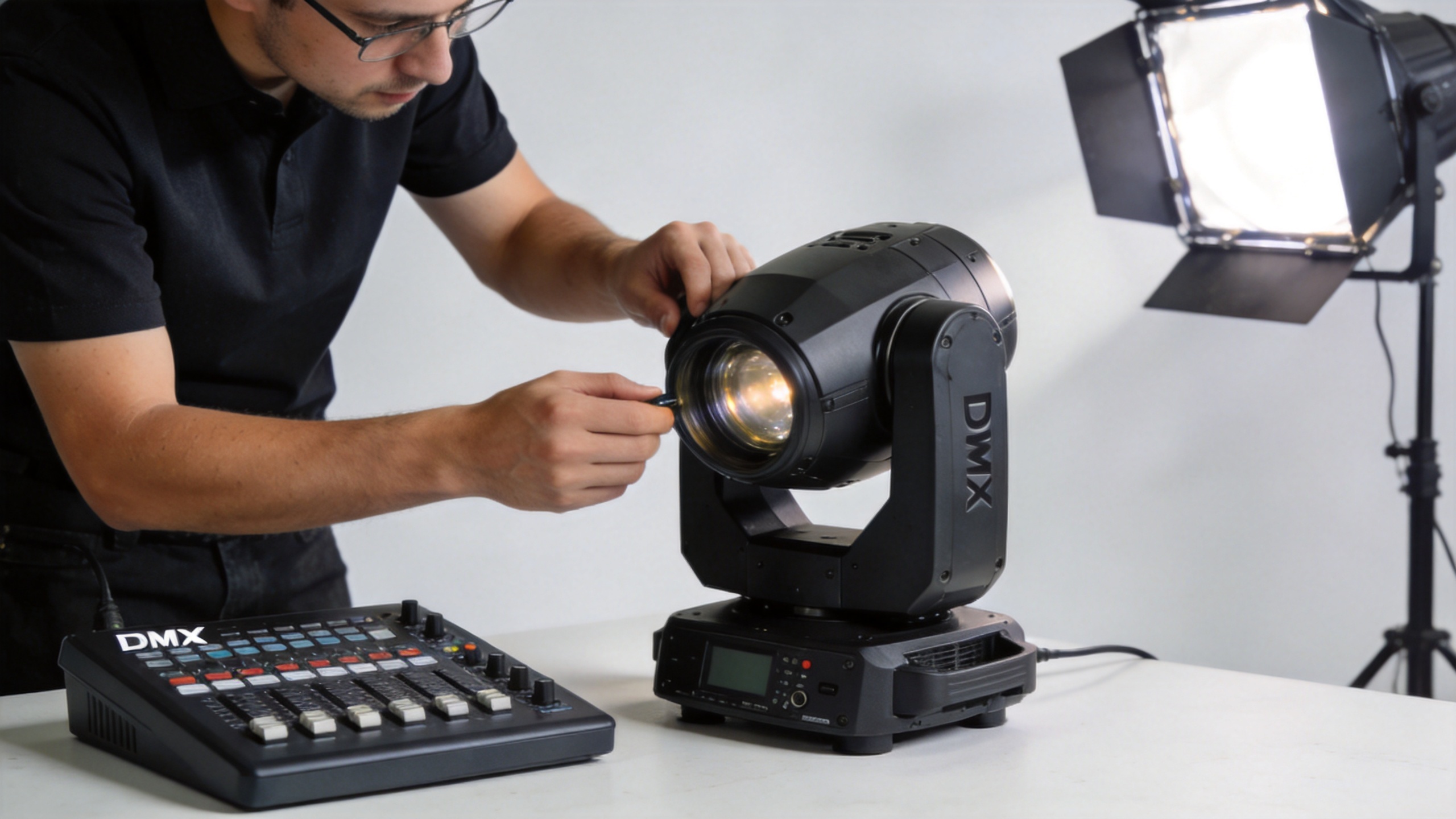
Specifications provide direction, but sample results still need to be tied to the actual production conditions. That is especially important when fixture revisions, carton artwork, or bundled control equipment are involved.
Ask for a quality process you can audit
Reliable stage lighting manufacturers should be able to explain how they control incoming components, assembly, functional testing, burn-in or aging where applicable, final inspection, and packing checks. The goal is not to demand a generic certificate list. The goal is to understand what evidence is available for your model and market.
For luminaire safety discussions, IEC 60598-1 covers general safety requirements for luminaires. It does not by itself prove that a particular OEM item is compliant in every destination. Ask the supplier which documentation applies to the quoted model, which test reports or declarations can be shared, who issued them, and whether the model, voltage, labeling, and destination market match your program.
| Evaluation area | What to request | Why it matters |
|---|---|---|
| Incoming materials | Key-component inspection approach and traceability method | Shows how critical parts are checked before assembly. |
| Functional tests | Test steps and pass/fail records for the quoted fixture | Connects the sample expectation to batch output. |
| Control verification | Channel-mode and controller test procedure | Reduces uncertainty around a dmx controller integration. |
| Market documentation | Model-specific reports, declarations, and labeling details | Helps your team validate claims before launch. |
| Change control | Revision notice and approval workflow | Prevents silent substitutions after sample approval. |
Turn lead time into a milestone plan
Lead time is more than the number of days printed on a quotation. For an OEM launch, separate the schedule into artwork confirmation, sample build, sample review, revision, material readiness, production, inspection, packing, and shipment handover. Then ask what information the supplier needs before each milestone can start.
Use an exception-oriented update rhythm. Instead of receiving only “production is on schedule,” ask for notice when an approval, component, test result, or artwork file could affect the committed date. This makes schedule risk visible early enough to decide whether to revise the plan, approve a change, or hold shipment.
When comparing stage lighting manufacturers, look for a clear answer to three questions: What is the current milestone? What evidence supports that status? Who owns the next action? A supplier that communicates these points consistently is easier to manage across repeat orders, especially when the dmx controller test and fixture documentation must stay aligned.
Score communication and aftermarket readiness
OEM work creates questions after the initial shipment: replacement-parts requests, controller files, documentation updates, packaging adjustments, and field feedback. Evaluate the communication process before committing to volume. Ask for escalation contacts, response expectations, the format for technical questions, and how model revisions are communicated to your team.
It is also sensible to request a spare-parts recommendation, but do not accept generic quantities without reference to your order profile, service model, and target market. The right plan for a distributor may differ from the plan for a rental company. Keep assumptions in writing.
Use a weighted OEM scorecard
Give every finalist the same evidence request and score specification fit, sample traceability, production inspection, documentation, control verification, schedule discipline, and service communication. Weight the categories according to your launch risk. For stage lighting manufacturers, a score should point to a drawing, test record, file, or confirmed answer—not just a positive impression.
During final review, ask who controls sample revisions, how production changes are reported, how the chosen dmx controller workflow will be tested, which dates depend on buyer approval, and which model-specific documents can be reviewed before shipment. This does not guarantee a trouble-free project, but it makes open risks visible early and creates a reusable way to compare stage lighting manufacturers.
A practical final checklist for OEM selection
Before selecting among stage lighting manufacturers, confirm that each finalist can provide answers and evidence for the same checklist:
- A complete OEM brief and a configuration-specific quotation.
- A documented sample-approval process and change-control rule.
- Product, controller, and channel-mode verification relevant to the project.
- Model- and market-specific quality and compliance documentation to review.
- A milestone schedule with named owners and exception reporting.
- Clear contacts for technical support, revisions, and after-sales coordination.
A sound choice is rarely the supplier with the broadest claim or the lowest initial quote. It is the manufacturer whose documented process gives your team the clearest way to validate the product, control the changes, and protect the delivery plan. Start with the checklist, approve the sample against it, and keep the same evidence trail through production.