 EN
EN



IP65 Moving Head Lights: When Does Outdoor Protection Matter?
An LED moving head may be specified for a stage because of its beam, movement, color, or control options. For an outdoor event, however, the first planning question is more basic: will the fixture face dust, rain, spray, wind-driven moisture, or repeated changes between storage and exposure? That is where an IP rating becomes useful.
IP65 is often treated as shorthand for “outdoor ready.” It is more accurate to read it as an enclosure-protection rating with a defined boundary. It can be highly relevant for an outdoor stage, but it does not remove the need to plan the whole lighting system around the actual weather, rigging position, cabling, drainage, and operating workflow.
What IP65 means for an LED moving head
For an LED moving head used beyond a dry indoor room, the IP code is a practical starting point. The IP code is used to describe how an enclosure resists the entry of solid objects and water. In IP65, the first digit, 6, indicates dust-tight protection. The second digit, 5, indicates protection against water jets under the relevant test conditions. In practical terms, an IP65 LED moving head is designed for exposure that would be inappropriate for a fixture intended only for dry indoor use.
That wording matters. The rating is about the enclosure and a stated test condition; it is not a promise that every part of a live outdoor installation is protected in every situation. Connectors, power distribution, signal paths, rigging hardware, cable routes, and any opened access point all need their own review.
A useful reframing is to move from “Is IP65 better?” to “Is this LED moving head exposed often enough that dust and water-jet protection should be part of the specification?” The answer depends on the venue and show plan, not on the label alone.
When outdoor protection matters most
For an LED moving head mounted outdoors, IP65 becomes a high-priority requirement when the fixture will be installed where weather exposure is part of normal operation rather than a rare emergency. Examples include open-air concert stages, festival rigs, outdoor architectural performance areas, resort events, temporary stages, and touring setups that move between covered and uncovered locations.
- Open-sided or uncovered stages: Rain can reach the fixture from directions a roofline does not block.
- Dusty festival grounds: Fine dust, road dust, and airborne debris can accumulate during load-in and operation.
- Near-water or wash-down environments: Spray, wet surfaces, and cleaning activities can change the exposure profile.
- Frequent outdoor rental use: Repeated packing, transport, setup, and changing weather make a clear protection specification more valuable.
- Installations with limited emergency access: If a fixture cannot be quickly moved or covered when conditions change, the protection decision deserves more attention.
For an indoor club, ballroom, or fully weather-protected stage, IP65 may be unnecessary. Paying for outdoor protection when the system will remain dry can add cost and weight without solving the most important lighting problem. This is why a venue-first review is more useful than treating IP65 as a universal upgrade.
What IP65 does not tell you
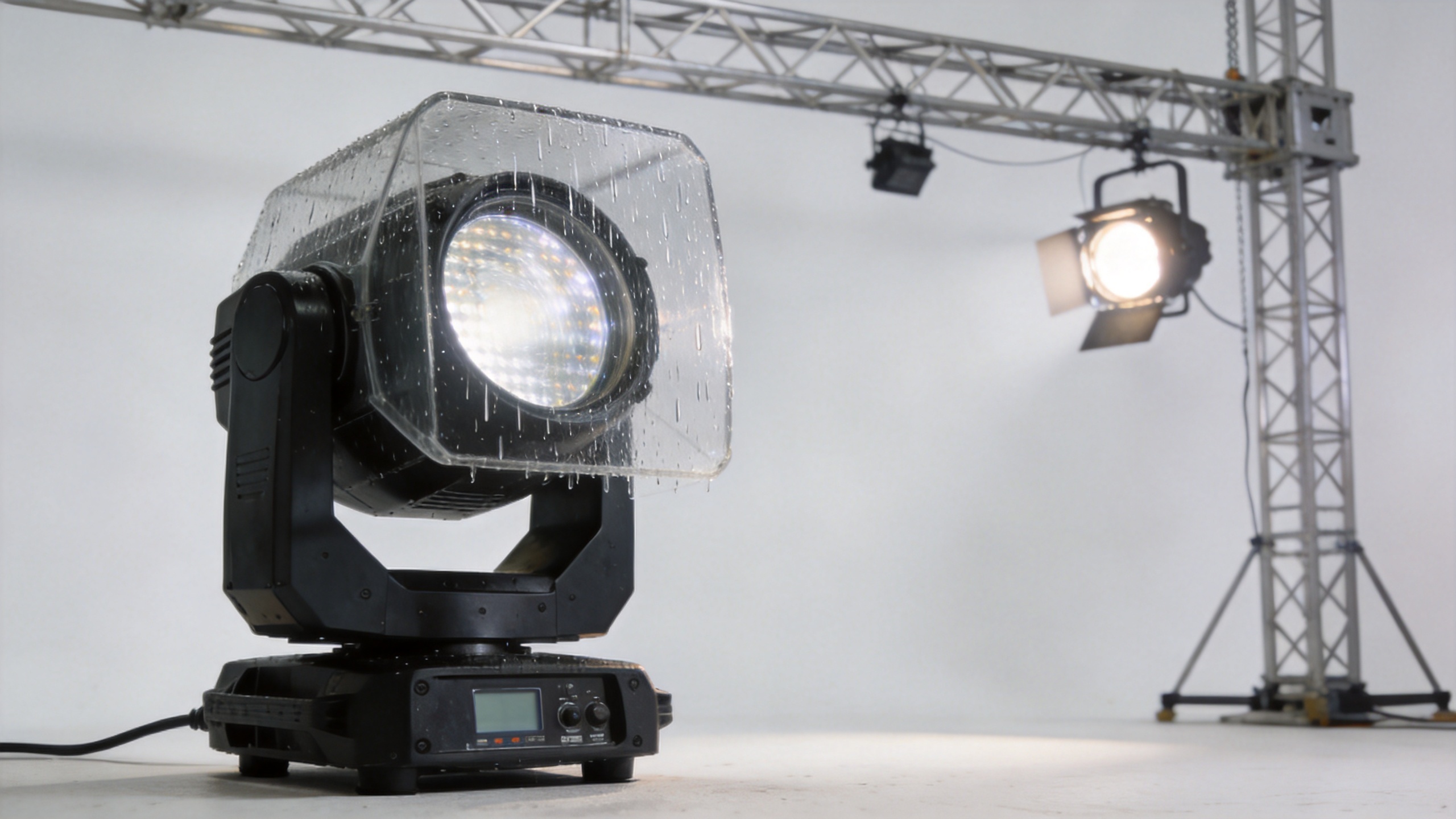
IP65 does not mean a fixture is suitable for immersion, flooding, standing water, or every severe-weather scenario. It also does not describe beam quality, brightness at a given throw distance, movement speed, optics, control compatibility, or the suitability of an LED moving head for your visual design.
Just as important, an IP rating does not automatically cover the full installation. A protected fixture can still be paired with unsuitable connectors or cable management. Before comparing models, clarify where power and data connections sit, whether they are protected during setup and operation, how water is kept from pooling around equipment, and what the crew will do if rain intensifies.
In planning conversations, this is usually worth clarifying before the specification list. A stage may have a canopy, for example, but wind-driven rain can still reach side-hung fixtures. Conversely, a properly enclosed, dry venue may make a non-IP fixture the sensible choice.
Use exposure scenarios instead of a simple indoor-versus-outdoor label
For an LED moving head, outdoor is not one condition. A short wedding program under a tent, a multi-day festival in an open field, and a semi-covered venue beside water create different demands. Start by mapping the likely exposure rather than relying on the word “outdoor.”
| Scenario | Why protection may matter | Questions to confirm |
|---|---|---|
| Covered temporary stage | Side spray, humidity, dust during load-in, and changing weather may still affect the rig. | How far does the roof extend? Can wind drive rain onto fixtures? Where are connectors located? |
| Open-air festival stage | Repeated exposure to dust and rain is more likely across long operating periods. | What is the weather plan? How will power, data, and cable routes be protected? |
| Indoor venue with doors open to weather | Exposure may be localized rather than constant. | Which fixture positions are near entrances or open walls? Is relocation possible? |
| Outdoor rental inventory | The fixture may serve many sites with variable conditions. | What are the inspection, drying, transport, and documentation routines between events? |
In each case, the LED moving head should be selected as one part of a system. The brighter or more feature-rich fixture is not automatically the better fit if its enclosure and deployment plan do not match the expected exposure.
A practical checklist before specifying an IP65 LED moving head
- Define the lighting role. Is the fixture needed for a visible beam, aerial movement, texture, wash coverage, or a combination? Start with the show goal before comparing specifications.
- Map the exposure zones. Identify positions exposed to rain, spray, dust, direct sun, wind, or runoff. A fixture under a roof and one on an open truss may need different protection decisions.
- Review the whole connection path. Ask how power, data, couplers, and cable routes will be protected. An enclosure rating does not eliminate these checks.
- Confirm current documentation. Check the current product documentation for the exact model, including the rating, intended use, installation limits, and maintenance guidance.
- Plan the weather response. Decide who monitors conditions, who can make the equipment safe, and what happens if the event pauses or exposure increases.
- Consider access and maintenance. Outdoor protection supports planning, but crews still need a workable inspection, cleaning, drying, and handoff routine.
What throw distance and visual target does your venue actually require? That question should sit beside the exposure checklist. A fixture's environmental protection and its lighting role are related decisions, but they are not the same decision.
How to evaluate a product page responsibly
When a supplier lists an IP65 LED moving head, ask whether that LED moving head will actually face the exposure described in the project brief., use the page as a starting point for a more specific technical conversation. The following product page can help you identify the model to discuss: IP65 1940W Bee-Eye Moving Light. Confirm the current documentation and project conditions before finalizing any fixture choice.
For an awareness-stage discussion, the goal is not to rank one model above every other option. It is to make the boundary clear: IP65 is worth prioritizing when dust and water exposure are realistic operating conditions and when the rest of the installation can support that protection strategy.
Conclusion: protection should match the event reality
An IP65 LED moving head can be a practical option for outdoor stages and other applications where dust and water exposure are part of the working environment. It is not a substitute for checking the full system, nor is it a reason to ignore lighting design, mounting position, control needs, or local requirements.
When selecting an LED moving head, begin with the venue and workflow, then verify the documentation and setup details that shape the visible result. If exposure is occasional and manageable, an indoor fixture may still fit. If exposure is routine, difficult to control, or costly to interrupt, outdoor protection should move from a nice-to-have to a core selection criterion.