 EN
EN



Moving Lights vs LED PAR Lights: Which Fits Your Venue?
When a venue needs a lighting refresh, the first question is rarely “Which fixture is the right fit?” A more useful question is: what must the room do during a show? Moving lights and LED PAR lights solve different parts of that problem. One adds motion, focus, and visual change; the other delivers stable color, broad washes, and straightforward coverage. For clubs, wedding venues, rental inventories, and small-to-mid-size stages, the strongest answer is often a deliberate mix rather than a single fixture type.
From an event-production buyer’s perspective, compare the effect goal, mounting positions, control plan, setup time, and operating workflow before comparing fixture counts. A fixture that looks impressive in a demo can be a poor fit if it creates too much programming work or leaves the stage without an even base wash.
Start with the visual job each fixture must perform
Moving lights are motorized fixtures that pan and tilt, allowing an operator or programmed cue list to place beams, patterns, and color in different parts of a venue. That makes moving lights useful when a performance needs directional energy: a performer entrance, a dance-floor moment, a band transition, or a focal point that changes during the set.
LED PAR lights are static fixtures. Their usual role is to create an even color field on a stage, backdrop, truss, wall, or architectural surface. They do not chase a subject around the room, but they can establish the atmosphere that makes the rest of the lighting system feel complete. In practice, LED PAR lights are often the dependable base layer, while moving lights create the changing accents above it.
That distinction matters because a single moving fixture rarely replaces a full wash plan, and a row of PAR fixtures rarely creates the directional drama of a coordinated movement cue. Higher output or more features do not automatically mean a better fit; venue size, sightlines, and the show format still decide the outcome.
Moving lights vs LED PAR lights: a venue-by-venue comparison
| Decision factor | Moving lights | LED PAR lights |
|---|---|---|
| Primary visual role | Dynamic beams, focus changes, aerial looks, and movement | Static color wash, stage coverage, uplighting, and background color |
| Venue need | Shows with cue changes, performers, DJs, or a visible focal point | Rooms that need consistent color and broad, even illumination |
| Installation planning | Needs clear movement paths and careful aiming from truss or elevated positions | Can be placed on floors, stands, truss, or architectural positions for coverage |
| Control workload | Benefits from programmed positions, palettes, and rehearsal time | Often simpler to group by zones and color looks |
| Typical system role | Accent and feature layer | Foundation and fill layer |
For a compact bar with a DJ booth, two or four moving lights can add a sense of motion that makes a small room feel more active. However, PAR fixtures may still do most of the practical work: washing the booth, coloring a rear wall, and keeping the room visually coherent between movement effects. For a wedding venue, LED PAR lights are often the first priority for room color and uplighting, while a smaller set of moving lights can be reserved for the dance floor or evening program.
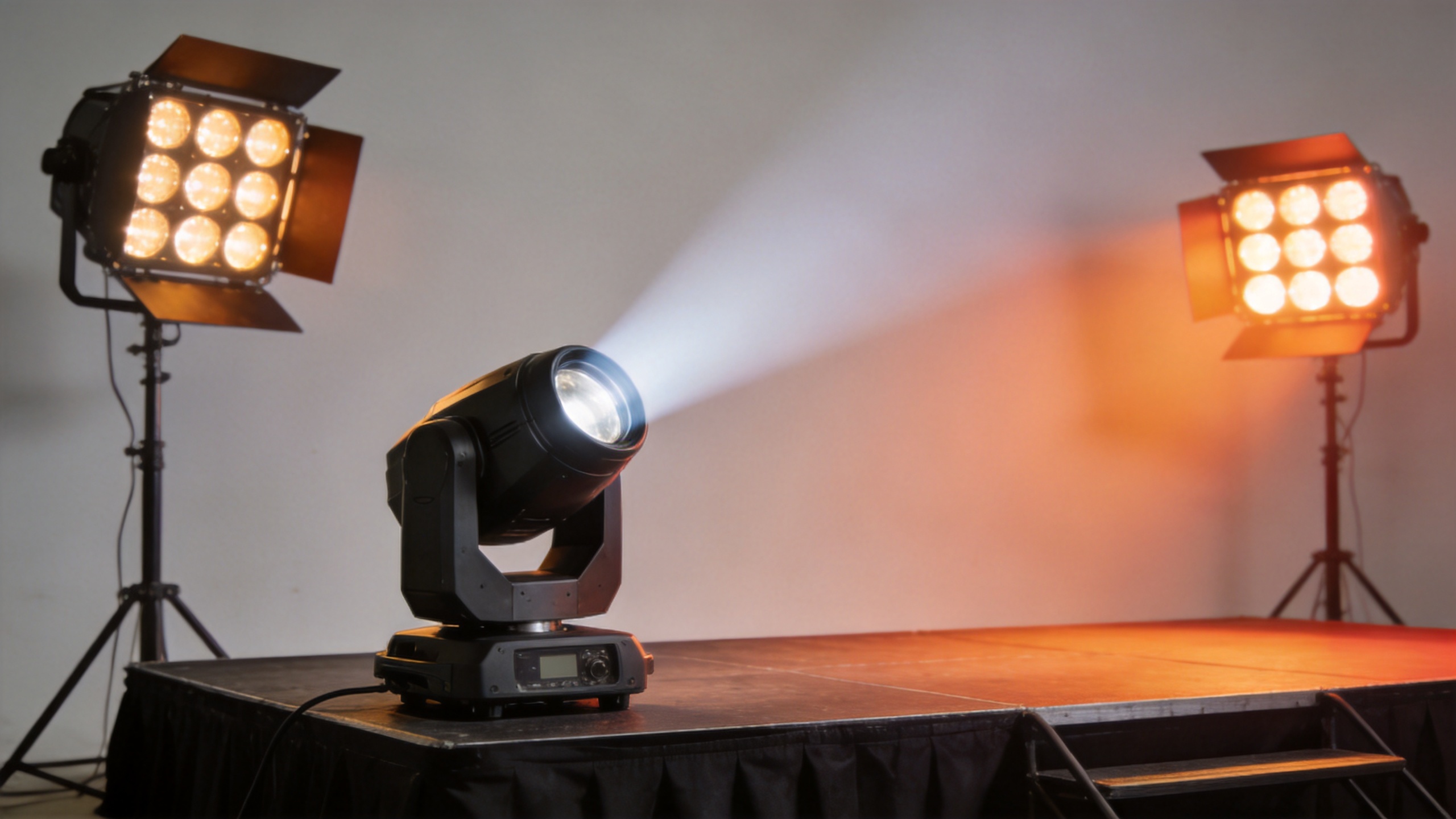
Compare motion, color wash, and installation before choosing
The central trade-off is not “premium” versus “basic.” It is focused movement versus stable coverage. Moving lights need room to move without repeatedly pointing into unwanted sightlines. Before specifying them, inspect ceiling height, truss positions, stage depth, audience viewing angles, and any scenic elements that may block the beam. More detailed control options also mean more preparation: positions, movement speeds, and cue timing must be checked before doors open.
LED PAR lights need a different kind of planning. Their effectiveness depends on fixture spacing, beam spread, distance to the surface, and color consistency across zones. If a backdrop looks patchy, the issue may be placement distance rather than the fixture itself. On an outdoor façade, patio, or temporary event area, weather exposure and mounting method should be verified against the actual product documentation rather than assumed from a category name.
For venues that need a weather-aware wash option, the confirmed product listing for the AICPOSE IP65 19×15W Zoom PAR Light | Outdoor Waterproof RGBW Wash can be reviewed as a potential static wash fixture. Its suitability should still be checked against the project’s mounting, control, electrical, and local safety requirements.
Build a practical system, not a fixture contest
For many venues, the most useful decision is a layered system. Use LED PAR lights to establish front, side, back, or architectural color; use moving lights where changing direction is visible and meaningful. This approach gives the lighting operator a stable canvas, then adds movement only when it supports the music, speaker, or moment on stage.
A rental company can also plan this way. PAR fixtures are flexible for recurring wash and uplight requests, while moving lights can be allocated to packages that justify programming time and transport preparation. If only price is compared, it is easy to miss whether the package includes the required control capacity, rigging positions, spares, and crew workflow.
A five-question venue checklist
- Where must the audience see continuous, even color? Assign LED PAR lights to these zones first.
- Which moments need visible direction or movement? Reserve moving lights for those cues.
- What mounting height and clear movement envelope are available?
- Who will program and operate the system, and how much rehearsal time is realistic?
- Will the installation face outdoor exposure, frequent changeovers, or different room layouts?
Ask these questions before committing to a fixture count. The right venue package is the one that creates repeatable looks with the crew, control system, and physical space actually available.
Which choice fits your venue?
Choose LED PAR lights first when the immediate need is broad color, wall washing, stage coverage, or a flexible base for multiple event formats. Prioritize moving lights when your venue needs evolving focal points, choreography, and stronger visual momentum during performances. For most professional rooms, combine both: PAR fixtures build the environment, and moving lights bring the moments to life.
Before purchase or installation, confirm current product specifications, control compatibility, rigging practices, and applicable safety requirements with the supplier and the venue team. That final check turns a promising lighting concept into a workable system.