 EN
EN



When to Use an Art-Net DMX Splitter in Event Lighting Networks
In a small room, a usb to dmx interface can be the sensible bridge between a lighting computer and one short fixture run. The decision changes when a show needs fixtures in several zones, a mix of moving heads and LED units, or cable routes that cannot safely depend on one daisy chain. At that point, the question is not simply whether a usb to dmx adapter works. It is whether the control system has a clear Ethernet-to-DMX handoff and protected branches where crews need them.
Art-Net carries lighting-control data across Ethernet, while DMX remains the local control signal delivered to fixtures. A usb to dmx interface is useful at the control end; an Art-Net node and a DMX splitter solve different parts of the distribution problem. Keeping those roles separate makes a temporary event network easier to plan, test, and recover during a busy load-in.
Start by separating USB, Art-Net, and DMX distribution
A usb to dmx device normally connects software on a computer to a DMX line. It can be enough for a modest rig with a single universe, a short cable run, and one practical physical chain. A DMX universe is commonly planned around up to 512 control channels, although the actual fixture count depends on each fixture’s active channel mode. That is a channel-planning limit, not permission to build an unlimited physical daisy chain.
Art-Net moves DMX or RDM lighting data over an Ethernet network. An Art-Net node converts the networked data into DMX outputs near the fixtures. A splitter then takes a DMX output and creates separate branches. So a usb to dmx connection may still be part of the system, but it should not be asked to replace network distribution, local conversion, or isolated branch protection.
When a USB-to-DMX interface is still enough
Keep the system simple when the controller is close to the fixtures, the rig uses one universe, and the physical route is short and easy to inspect. A usb to dmx interface can be a practical fit for a rehearsal room, compact DJ setup, small bar installation, or a controlled test bench. It is also useful for proving fixture personalities and addressing before a larger network is assembled.
However, simplicity should be real rather than assumed. Confirm the software and interface compatibility, fixture channel count, connector type, and termination requirement. If the run crosses several production areas or serves separate truss positions, a single usb to dmx line may be technically possible yet operationally inconvenient. One loose connector or one faulty fixture can then affect every downstream unit.
Use Art-Net when the event needs distribution by location
Art-Net becomes more useful when the control position and fixture groups are far apart, when several universes are required, or when the venue already has an Ethernet infrastructure for production. Instead of extending one long DMX path from a usb to dmx interface, the production team can place nodes near stage left, stage right, FOH, backstage, or an outdoor lighting position. Each node converts only the data needed locally.
This approach also supports a cleaner handoff between departments. The lighting programmer can keep a usb to dmx interface at the programming workstation if the workflow requires it, while the network carries Art-Net to remote nodes. Before show day, document the IP plan, universe-to-port mapping, switch locations, and a fallback path. Use suitable network equipment and validate multicast or broadcast behavior against the chosen Art-Net implementation rather than assuming any office network is ready for production traffic.
When a DMX splitter becomes the better choice
Add a DMX splitter when one converted DMX output must serve physically separate branches: for example, two trusses, a front wash position, and a floor package. A splitter reduces the need to route every fixture through one chain. More importantly, models with isolated outputs can help contain a fault on one branch instead of allowing it to affect the whole distribution path. That benefit should be verified in the product documentation; not every splitter or Art-Net node has the same isolation or RDM behavior.
A splitter is especially valuable when a usb to dmx source feeds a system with frequent reconfiguration, rental handovers, or multiple fixture families. The same logic applies if a remote Art-Net node produces the DMX signal. The splitter is not an Ethernet switch and does not create additional Art-Net universes. It is a downstream DMX distribution tool, so it belongs after the conversion point.
A practical decision framework for event crews
| Situation | Recommended approach | Why |
|---|---|---|
| One compact, local fixture chain | USB-to-DMX interface and one terminated DMX line | Lowest setup complexity when the route is short and controlled. |
| Fixtures in several venue zones | Art-Net network with nodes near each zone | Reduces long DMX runs and organizes output by location. |
| One local DMX output must feed multiple branches | DMX splitter after the interface or node | Creates manageable branch paths and may provide isolation. |
| Multiple universes or high channel demand | Art-Net nodes with an explicit universe map | Scales beyond a single usb to dmx line. |
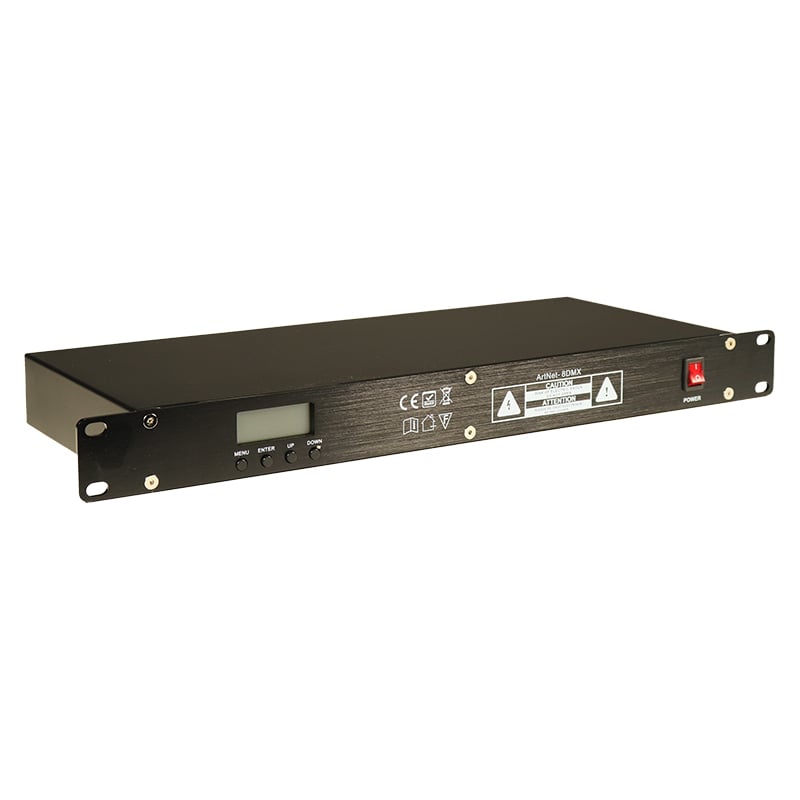
For an eight-branch distribution option, review the available 8-way DMX Splitter Booster with ArtNet alongside the current project requirements. Confirm port direction, isolation, RDM support, connectors, power arrangement, and network configuration from the current product documentation before specifying it.
Pre-show checks that prevent avoidable faults
- Map every usb to dmx, Art-Net node, DMX universe, and physical branch before patching.
- Label both ends of Ethernet and DMX cables with the location and intended universe.
- Terminate each final DMX branch as required by the fixture and splitter documentation.
- Test one branch at a time, then test the complete cueing workflow.
- For RDM use, confirm the path supports the intended discovery and return-data behavior; do not assume it passes through every device.
- Keep a known-good usb to dmx path or local playback option for the level of redundancy the show requires.
Choose the topology, not just the adapter
The right answer is rarely “use a splitter in every case” or “use Art-Net in every case.” Use a usb to dmx interface for direct, local control; use Art-Net when Ethernet is the better way to move control data across the event footprint; and use a DMX splitter when one local DMX output needs dependable physical branches. If the layout is uncertain, begin with a universe map and a cable-route sketch. That small planning step usually exposes whether the limiting factor is channels, distance, branching, network layout, or the need to isolate a field fault.